Delivery in 2-3 working days

What is a TV audio amplifier?
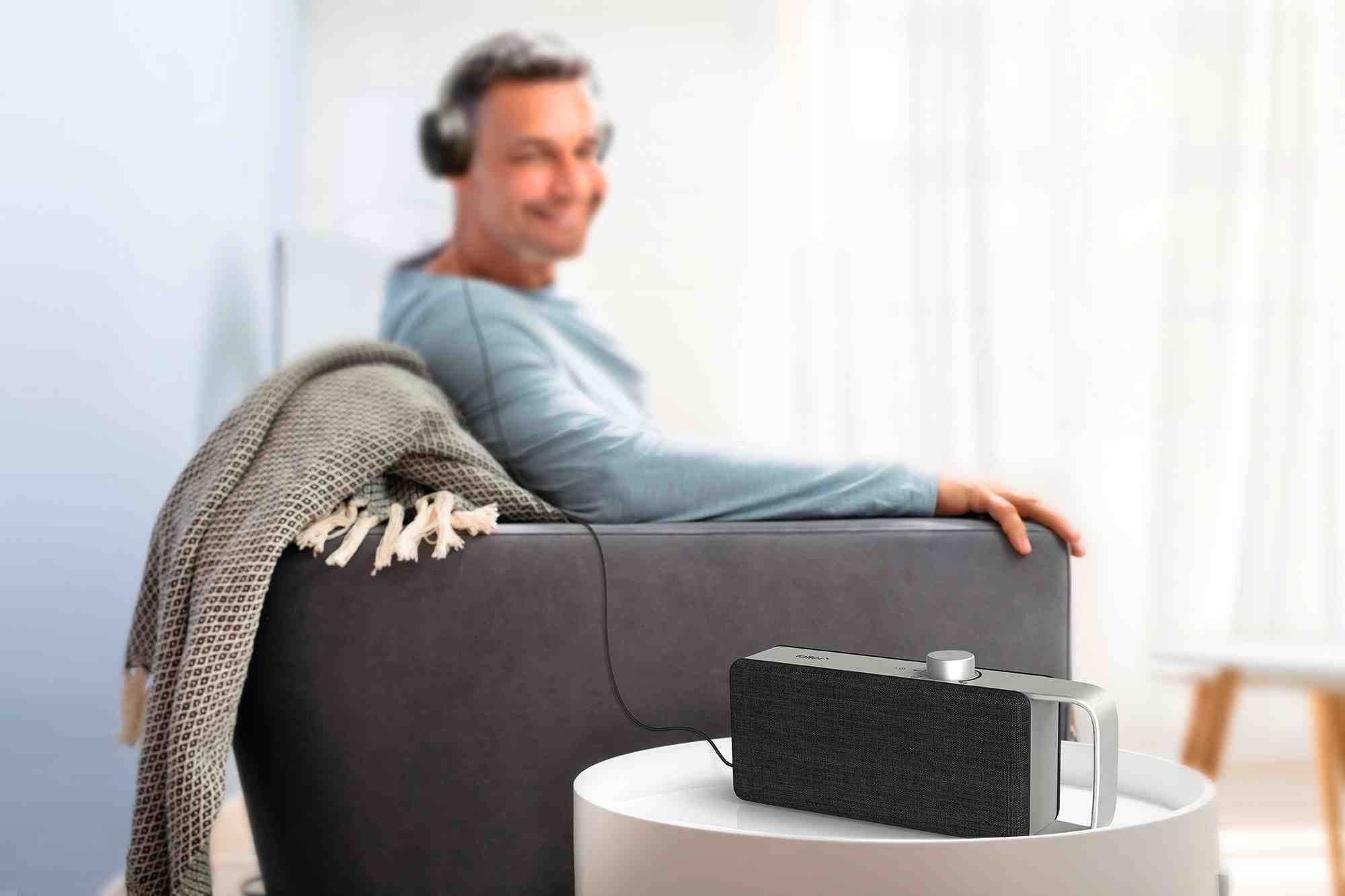
A TV audio amplifier is a device that individually brings the TV sound closer to the listener's seat. It picks up the sound from the TV and plays it back closer to the ear (i.e., at the seat), making it easier and clearer to understand what is being said without having to turn up the TV volume for everyone in the room.
This makes a TV audio amplifier particularly useful when dialogue is hard to understand or when several people with different hearing abilities are watching TV together. The types of devices available, how they differ, and who they’re best suited for depend on personal needs and preferences.
What is a TV audio amplifier?
A TV audio amplifier is a small device that picks up the sound from the TV, amplifies it, and directs it toward the listener's seating area. Instead of turning up the TV volume, the sound is directed straight to the seating area or the listener's ear, where it can be heard more clearly. Some devices also slightly emphasize speech to make dialogue sound clearer.
The term “TV audio amplifier” is widely used and refers to both headphone models and small speakers that you place next to you. What they all have in common is that they make the TV sound louder and clearer for each individual.
A TV audio amplifier works on the transmission path, not on the broadcast itself. It makes the sound louder and brings it closer, but it does not remix the TV audio, which is inherently dense. With simple devices that lack a speech function, everything becomes uniformly louder—that is, both speech and background noise—while models with additional speech optimization make the speech stand out even more.
How a TV Audio Amplifier Works
The basic principle is the same for most devices. The sound is picked up from the TV and transmitted to the ear via a shorter path, so less sound is lost along the way.
From the TV to the device
The connection is usually made via a small base station that is connected to the TV with an audio cable, often through the optical audio output or the headphone jack. An optical cable transmits the audio digitally, while the headphone jack transmits it analog. Both methods are suitable for a hearing amplifier. From there, the base station transmits the audio wirelessly to the receiver or speaker.
Louder and closer to the listening position
The actual effect is created by the proximity and the perceived volume. Because the sound reaches the seat or the ear directly, it no longer has to travel across the entire room. The volume can be adjusted independently of the TV, so that everyone can choose their own level. This independent volume control is particularly advantageous when watching TV together, because it allows the TV itself to remain at a lower volume.
Highlight language
Some devices also improve speech intelligibility by slightly boosting voices relative to music and background noise. The extent of this effect varies from device to device. With basic models, the sound is primarily made louder, while more advanced models are also tuned more clearly for speech. This difference is often more important for speech intelligibility than sheer volume.
What types of TV audio amplifiers are available?
The term “TV hearing amplifier” encompasses several different designs that vary significantly in terms of comfort and usage.
| Design | Carry or Set Up | Well suited for | Distinctive Feature |
|---|---|---|---|
| Wireless headphones | Over or on the ear | watching TV alone and with full concentration | largely excludes the surrounding area |
| Over-the-ear headphones | Lightweight strap under the chin | Watching TV for a long time, putting it on and taking it off quickly | doesn't put pressure on your ears |
| Speaker for the seat | It's next to the armchair | Watching TV together, casual conversations | Others can listen in; the room remains open |
The right design depends primarily on whether you watch TV alone or with others, and how long you plan to wear the device at a time.
Over-ear and under-chin headphone styles provide a very personalized sound experience, but they also block out ambient noise. A speaker placed at your seat allows you to watch TV together and have conversations in the room without anyone having to wear headphones. If you’re unsure, you can first consider whether you want to be able to hear what’s going on around you while watching TV and whether you’re generally comfortable wearing headphones—even for extended periods of time.
Who Should Use a TV Audio Amplifier
A TV audio amplifier is a worthwhile investment whenever the standard TV audio reaches its limits—often due to personal preferences or limitations.
When dialog is hard to understand
When voices get lost in the TV audio and you find yourself asking others to repeat themselves or rewinding the recording often, a hearing amplifier brings the sound closer and louder to your ear. This helps you catch the dialogue again without constantly having to adjust the volume. This isn’t just an issue for older viewers, but also for modern sound mixes in which music and sound effects are layered closely over the dialogue.
If you want the volume to stay low
Late at night or in a room with thin walls, you often don’t want the TV to disturb anyone. With a headphone amplifier, you can adjust the volume to a level that’s loud enough for you, while keeping the room quiet. This is also helpful for anyone who doesn’t want to wake sleeping children or neighbors, as you can hear the sound only from your own seat.
While watching TV together
When two people have different levels of hearing, arguments about the volume can quickly arise. A hearing amplifier decouples each person’s volume from the TV, so that both can set their own preferred level. That way, no one has to give up their usual volume just because their hearing differs.
What to Look for When Making a Choice
The right device for you depends on your TV, where you watch it, and your personal habits. It’s worth clarifying a few points beforehand.
Connection and Link
It’s important that the device is compatible with the TV’s audio outputs, such as the optical output or the headphone jack. The wireless range should also be sufficient for the distance between the TV and where you’re sitting, so that the audio remains stable. For very new TVs without a traditional headphone jack, the optical output is often the most reliable option. Depending on the device, other connection types may also be relevant. The key factor is which audio outputs your TV actually offers.
Operation and Battery
Simple operation with just a few buttons or a dial makes everyday life easier. For wireless devices, battery life is also important so that a long evening of TV isn't interrupted by the need to recharge.
Sound and Speech Clarity
Not every device sounds the same. Some mainly turn up the volume, while others specifically emphasize speech. If you’re using the amplifier primarily because of unclear dialogue, you should focus on audible speech clarity rather than just maximum volume, because simply turning up the volume also amplifies the background noise.
Listen alone or together
If you usually watch TV alone, headphones or a chin-strap headset may be a good choice if you find them comfortable. If you often watch TV with a partner or in a group, a speaker mounted at your seat is a better option because it doesn't shut out the surroundings.
OSKAR a TV audio amplifier
One example of a speaker-based model is OSKAR TV speaker. This portable device sits next to the viewer’s seat and makes the TV sound louder and closer, while keeping the room open so others can still hear it. This makes OSKAR type of speaker among TV hearing amplifiers, just as wireless headphones and over-the-ear headphones are distinct designs.
Frequently asked questions
A TV hearing amplifier is a device that picks up the TV audio, amplifies it, and delivers it closer to the listener. This makes it easier to follow the dialogue without having to turn up the TV volume for everyone. Hearing amplifiers are available as wireless or chin-strap headphones, as well as small speakers for the seat.
A base station is connected to the TV via an audio cable, usually to the optical output or the headphone jack. From there, the sound is transmitted wirelessly to the headset or to the speaker at the seat. The volume can be adjusted independently of the TV, and some devices also enhance speech clarity.
This is especially useful for anyone who has trouble understanding dialogue on TV, wants to keep the volume low in the evening, or watches TV with a partner who has different hearing needs. The sound comes closer to your ear and can be adjusted to your personal preference without having to turn up the TV volume for the entire room.
Wireless headphones and over-the-ear headphones, which deliver sound directly to the ear, are common, as are small speakers that you can place next to your seat. Headphones block out ambient noise, while a speaker allows you to watch TV and have conversations with others.
Important factors include the right connection to the TV, sufficient wireless range, ease of use, and—for wireless devices—battery life.