Delivery in 2-3 working days

What is a subwoofer?
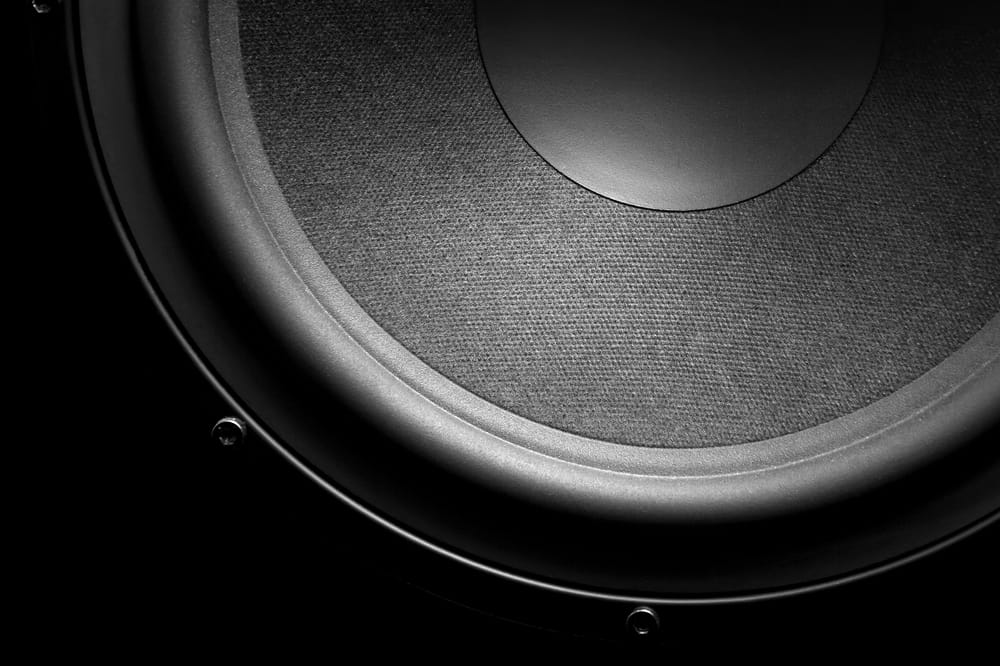
A subwoofer is a speaker designed to reproduce very low frequencies. It complements the other speakers where their bass reproduction reaches its limits. In a home theater, it provides that characteristic deep, thumping bass for explosions, footsteps, movie soundtracks, and more.
Anyone who wants to improve the overall TV sound—not just the sound from the TV itself—will eventually consider getting a subwoofer. It does indeed add significant value in terms of impact and richness. However, it does little to nothing to improve dialogue. Speech occurs in entirely different frequency bands, and in some cases, powerful bass can actually make listening more tiring.
Purpose and Frequency Range
Every speaker has a frequency range that it reproduces well. Above and below that range, the speaker struggles to reproduce sound. For small enclosures, low frequencies are essentially in the less important category. This is exactly where a subwoofer comes in. It then leaves everything above its range to the other speakers. In living room audio systems, a subwoofer is often a useful addition.
The lowest part of the frequency range
A subwoofer operates in the range where sounds are perceived more as a rumble than as actual sound. Its enclosure is significantly larger than that of a standard speaker, and the cone also has a larger diameter. The reason for this is quite simple: low frequencies have long wavelengths and require a large volume of moving air to produce even a barely audible level of sound.
The upper limit of this range depends on the device and the settings. The effects channel in multichannel systems serves as a guide. It is generally set to cover a range of roughly 20 to 120 hertz. Above that, the other speakers take over.
However, the Hertz specifications only indicate the range in which the device operates, not how evenly it does so. A model that theoretically reaches very low frequencies can still produce a rumbling sound in a small room. Conversely, a compact enclosure is often sufficient because the room itself amplifies the low-frequency components.
The volume required for low notes
Hearing sensitivity varies across the frequency range. The equal-loudness contours (according to ISO 226) show that a low-frequency sound requires a significantly higher sound pressure level than a mid-frequency sound for both to be perceived as equally loud. This requirement increases sharply as the frequency drops to the very low end.
This has a practical implication. A speaker designed to reproduce the low frequencies must be able to deliver a lot of power in that range. However, it is only relieved of this burden if a crossover actually takes those frequencies off its hands. Smaller speakers can thus limit themselves to the range they handle better.
The Effects Channel in Multichannel Systems
In multichannel formats such as 5.1, the designation after the period refers to the additional effects channel, known in English as the Low Frequency Effects Channel. It is transmitted separately from the rest of the audio and is intentionally narrowband. For film and broadcast, playback is designed to have a level boost of 10 decibels relative to the main channels. Good to know: This is handled differently in some music formats.
This should be distinguished from designations such as “2.1” for speaker systems. In that context, the designation usually only indicates that a subwoofer is included with two main speakers. It does not refer to a separate effects channel in the source material. The effects channel is a signal path in the audio mix, whereas the subwoofer is a speaker in the room. Via bass management, the subwoofer also handles the low-frequency components from the normal audio channels.
Structure and Designs
From the outside, a subwoofer usually looks unremarkable—often like a simple cube. Inside, however, there is a whole range of mechanisms that shape its sound character. These include the driver, the amplifier, the radiation pattern, and the enclosure design.
From the Voice Coil to Moving Air
Inside is the woofer—that is, the actual driver, consisting of a voice coil within a magnetic field. When current flows through the coil, a force is generated and the coil moves back and forth. Attached to the coil is the diaphragm, which displaces air as it moves, thereby generating sound waves. Two components keep the diaphragm on track: the centering spider inside and the surround around the edge.
Because low frequencies require large excursions, these components are built more robustly in a subwoofer than in a tweeter. The devices’ data sheets include specifications such as impedance, power handling, and frequency range. These values describe the “limits” of the device.
Active and passive versions
An active subwoofer has a built-in amplifier and therefore requires its own power outlet. It is connected via a signal cable, usually to a dedicated output on the amplifier or soundbar. This design is the norm and can be used without any additional accessories.
A passive subwoofer, on the other hand, consists only of the driver and the enclosure. It requires an external amplifier that delivers sufficient power in the low-frequency range. Such solutions are more commonly found in professional-grade systems. They are of little use when connecting to a TV.
Many active devices no longer require signal cables. The signal is transmitted via a dedicated wireless connection between the soundbar and the subwoofer, or, less commonly, via Bluetooth. The device still requires power, so it’s never completely wireless. With permanently paired sets, the subwoofer usually cannot be replaced with a different model.
Beam Direction and Installation Options
Another difference concerns the direction in which the speaker cabinet operates. In a front-firing model, the cone faces forward into the room, while in a down-firing model, it faces downward toward the floor. However, for optimal sound reproduction, the positioning, the distance from walls, and the interaction with the room are the most important factors.
For this reason, the surface on which the speaker is placed is also important. A down-firing enclosure requires sufficient airflow between the diaphragm and the floor, which is why a thick-pile carpet can be problematic in this case. The same applies to the port of a bass-reflex enclosure, which should also not be blocked.
Sealed, bass reflex, and bandpass
A sealed enclosure is airtight. The trapped air acts as an additional spring for the diaphragm. This design requires more power to achieve the same sound level, but has a flatter response below its operating range.
A bass-reflex enclosure has a tuned opening, known as a tube or port. The air inside it resonates, boosting a specific frequency range, which results in higher sound pressure levels at the same power. Below the tuning frequency, however, the sound pressure level drops more rapidly. The different designs thus differ primarily in terms of efficiency, the lower cutoff frequency, and the response below that frequency.
Placement and Setup in the Living Room
With a subwoofer, its position in the room plays a more important role than with any other speaker. The same unit can boom in one spot and be barely audible just two meters away. The reason lies in the physics of long waves, which bounce off the walls and ceiling in the listening room.
Room Acoustics and Uneven Bass Distribution
Low-frequency sounds have wavelengths in the range of several meters—roughly the size of a living room. This causes standing waves to form between opposite walls; these are called room modes. In some places, the waves add together and the bass becomes loud; in others, they partially cancel each other out.
Low frequencies provide significantly less clear directional information than higher frequencies. A subwoofer with a deep crossover is therefore usually more difficult to pinpoint as a single sound source. This allows for flexibility in placement, which you should take advantage of. The key factor is not so much which direction the subwoofer is pointing, but where it is located.
Find the location step by step
The best way to find the right spot is by trial and error. Even small changes in position can audibly affect how evenly the bass is distributed throughout the room.
- Temporarily place the subwoofer at your listening position.
- Play a movie scene or a piece of music with a steady bass line on a loop.
- Check the possible locations in the room one by one, listening close to the floor at each one—roughly at the height of where the item will eventually be placed.
- Choose the spot where the bass sounds balanced and individual notes neither stand out nor fade away.
- Place the subwoofer there and check the result again from your usual listening position.
Placing the speaker in a corner can significantly increase the bass level, but it also strongly excites room modes. It’s therefore worth trying out several locations instead of just placing the speaker in the nearest corner. However, small adjustments of just a few centimeters make little difference at wavelengths of several meters.
Crossover Frequency, Phase, and Level
Active subwoofers usually have three controls on the back. Together, they determine how well the subwoofer blends into the overall sound.
- The crossover frequency, also known as the cutoff frequency, determines the maximum frequency at which the subwoofer operates. It should be set at the point where the main speakers’ response begins to roll off. The steepness of the transition is determined by the crossover network inside the unit.
- The phase control shifts the signal in time. If it is set incorrectly, the subwoofer and main speakers will cancel each other out in the crossover region.
- The level control determines the volume relative to the rest. Setting it too high is the most common mistake when setting up the system.
A good rule of thumb is a bass that is noticeable when it’s missing but isn’t perceptible as a separate sound source. If the subwoofer can be clearly pinpointed, you should consider the crossover frequency in addition to the volume level. Many amplifiers also include an automatic calibration feature, which can provide a very useful starting point in some cases.
Subwoofers and Speech Intelligibility
Many people buy a subwoofer because the sound from their TV is unsatisfactory. It does work when it comes to punch and richness. However, anyone who wants to improve dialogue and vocals in particular will be disappointed. A subwoofer won't help in this case.
Speech Intelligibility and Frequencies
The mid and high frequencies are particularly important for speech intelligibility. That’s where many of the sounds that help us distinguish words are found. A subwoofer, on the other hand, operates in the low-frequency range and therefore does little to make dialogue clearer.
Too much bass in the sound
If the subwoofer is set too loud, the bass can drown out other parts of the audio mix. This is especially noticeable in movies with a lot of music, sound effects, and low-frequency sounds. Simply turning up the volume usually doesn’t help, because both the dialogue and the bass become louder at the same time.
Placement also plays a role. If the room amplifies certain low frequencies, the bass can quickly become boomy and linger longer. In that case, it’s worth readjusting the subwoofer’s location and, above all, its volume.
Recommended settings for clearer dialogs
If your main goal is to understand speech better, you should first check your TV's audio settings. Depending on the device, you can boost the midrange or enable a speech mode. Speech-optimized audio tracks can also help, since they already separate music and background noise more effectively from the dialogue.
If the speech is still unclear, the distance from the TV may also be a factor. The farther the sound travels through the room, the more reflections interfere with it. A hearing solution placed closer to the seating area therefore addresses the issue in a completely different way than an additional subwoofer.
Frequently asked questions
It fills in the gaps where flat-screen TVs and slim soundbars fall short. This is most noticeable with movie soundtracks, sound effects, and low-frequency sounds that would otherwise sound thin. With news or talk shows, however, the difference is minimal because those programs contain very few low-frequency elements. The benefit, therefore, depends heavily on what you watch most often.
As a rule, it doesn’t help. The device operates below the frequency ranges that are critical for intelligibility. A high bass level can further mask the dialogue. Anyone who buys a subwoofer to fix unclear dialogue is therefore investing in the wrong thing. It makes more sense to first check the sound settings and then consider how far the sound has to travel through the room.
In an amplifier's menu, you'll find these two terms listed separately. The "LFE" setting specifies how the additional channel in the source material is handled. The "Subwoofer" or "Bass Management" setting, on the other hand, determines which low-frequency components from the other speakers are routed to the device. If you configure only one of these settings and overlook the other, you'll end up with either too little or too much bass.
Low frequencies are less effectively dampened by walls and ceilings than higher ones, which is why bass, in particular, carries into neighboring apartments. Some of it also travels through the floor as structure-borne sound. An isolation mat can reduce this mechanical transmission, but it does not block airborne sound traveling through the masonry. In homes with thin walls, keeping the volume low is particularly helpful.
Usually not, because the vast majority of TVs lack a suitable output. The standard approach is to use an amplifier or a soundbar that has the appropriate connection or supports wireless connectivity. Some TV-soundbar sets come paired out of the box and cannot be paired with third-party devices. Checking the connections on both devices will clarify this beforehand.