
TV Speech Amplifier or TV Hearing Amplifier
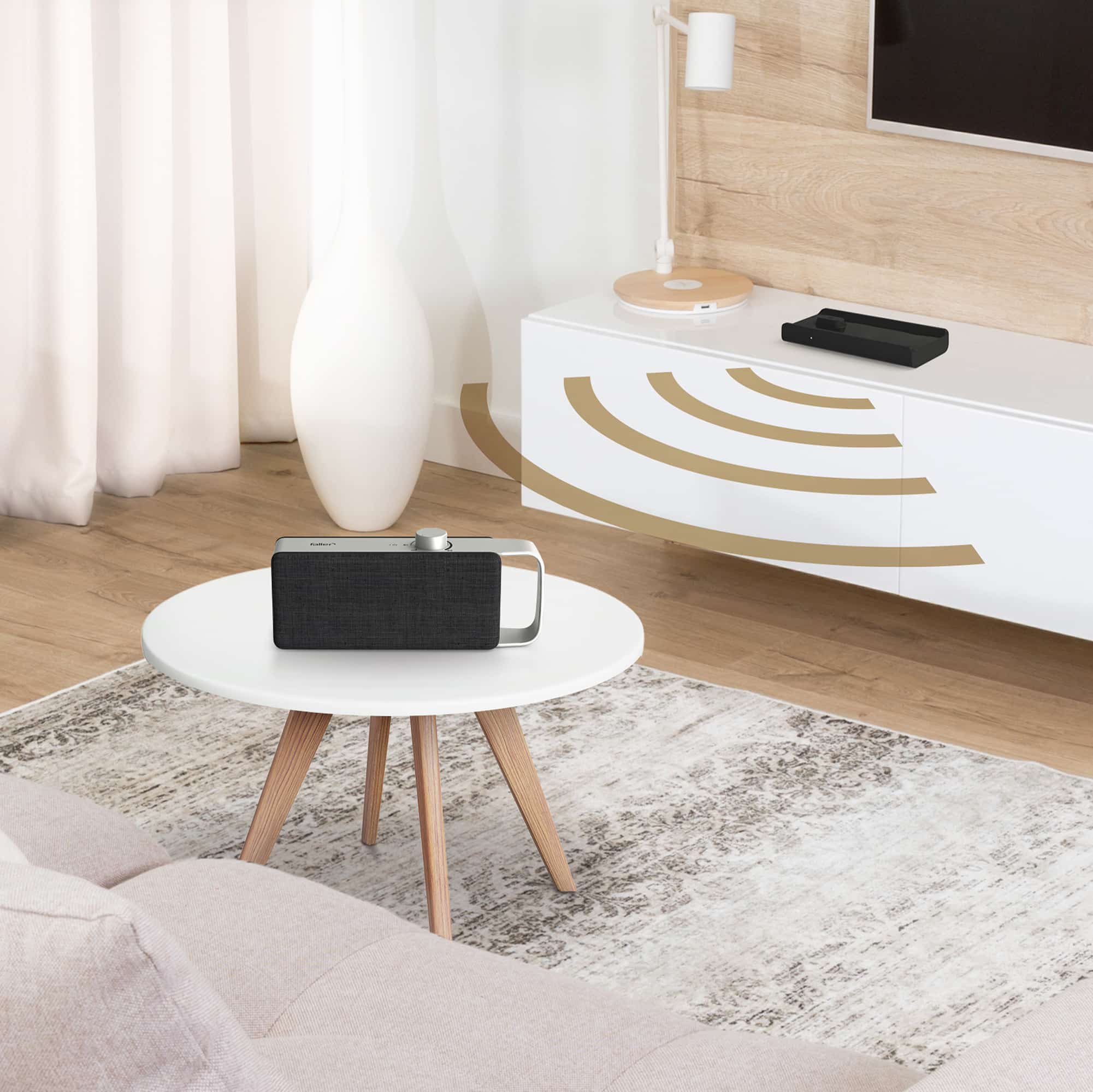
TV speech amplifiers and TV hearing amplifiers are often treated as two competing types of devices. In reality, these terms do not describe an “either/or” situation, but rather a relationship between a device category and a subgroup. Every speech amplifier is a hearing amplifier; the reverse is not true.
The difference lies in what happens to the sound before it reaches the listener. A hearing amplifier brings the sound closer and makes it louder. A speech amplifier additionally processes the signal and emphasizes the range of the human voice.
Two Terms, One Device Family
Both terms refer to devices for the same fundamental problem. The television is several feet away, and the sound loses clarity over this distance. Simply turning up the volume won’t solve the problem. Therefore, both types of devices pick up the sound from the TV and deliver it to the seating area. The setup is consequently the same: a base station at the TV, and a receiver where you are seated.
The Hearing Amplifier as an Umbrella Term
The hearing amplifier is the broader term. It describes any device that picks up, amplifies, and brings television sound closer to the listening position. This includes portable speakers as well as headphone solutions with their own transmitting station. The commonality of these devices is that they tap into the TV sound and allow its volume to be controlled independently of the TV.
The major advantage of these solutions is that the sound reaches the listener from just a few inches away. This means significantly more direct sound reaches the ear than from two to four or more feet, which is why a lower volume is sufficient here.
The Speech Amplifier as a Special Case
The speech amplifier does the same and goes a step further. It modifies the signal before it reaches the listener. The frequency range of the human voice is boosted, while music, effects, and atmosphere recede. This shifts the balance between speech and background noise. Thus, not everything becomes louder equally; instead, speech stands out.
This is precisely where the practical difference lies. Simply increasing volume boosts dialogues and explosions equally. Speech processing specifically enhances what is crucial for understanding. The balance between speech and other audio is the decisive factor for the intelligibility of dialogues in media content.
The Differences at a Glance
The following comparison shows where the two types of devices overlap and where they diverge. The first aspects are the same for both, as a speech amplifier inherently possesses the characteristics of a hearing amplifier.
| Feature | TV Hearing Amplifier | TV Speech Amplifier |
|---|---|---|
| Basic Principle | Sound closer to listening position | Sound closer to listening position |
| Structure | Base station and portable device | Base station and portable device |
| Independent Volume Control | Yes | Yes |
| Intervention in Audio Signal | Usually none | Speech is emphasized |
| Adjustable Speech Filters | Rare | Common |
| Helps with excessively quiet sound | Yes | Yes |
| Helps with unclear dialogues | Limited | Yes |
The first three aspects are identical because a speech amplifier belongs to the category of hearing amplifiers. The difference only arises from the intervention in the audio signal.
Inconsistent Terminology in the Market
In product descriptions, both words are often used synonymously. This isn’t entirely wrong. A device with speech processing can legitimately call itself a hearing amplifier because it meets the requirements of this category. Conversely, the term speech amplifier is sometimes used for devices that merely make the sound louder, which isn’t strictly accurate. However, there is no protected definition for either term.
For selection, this specifically means: The terms TV speech amplifier and TV hearing amplifier alone initially say little about their specific properties. A more revealing question is whether the device includes adjustable filters for speech or only a volume control.
OSKAR Fulfills Both Functions
OSKAR falls into both categories: The device brings the sound to the listening position and additionally processes it for speech enhancement.
Sound at the Listening Position
A base station is connected to the television, either via the HDMI-ARC port, the optical output, or the jack socket. From there, the sound is transmitted wirelessly to the portable device, which sits next to the armchair or on the table. The volume is controlled on the device itself, independently of the television.
This fulfills the basic function of a hearing amplifier. The TV can be played at a lower volume or continue playing for others in the room, while the appropriate volume is available at one’s own seat. The base station also serves as a charging cradle, so the device is charged between TV evenings.
Four Filter Levels for Dialogues
Additionally, OSKAR intervenes in the signal. Four filter levels can be selected on the device to emphasize voices over music and effects. Which level is best depends on the input and your personal preference and can be changed during operation. News and talk shows, for example, usually require a different setting than a film with a dense soundtrack.
Only this processing transforms the TV hearing amplifier into a TV speech amplifier. It is the reason why both designations apply to OSKAR. The filter levels are therefore a separate adjustment point on the device, distinct from the volume.
Finding the Right Function
Regardless of the designation, solving the problem is paramount. Two situations can be distinguished, each placing different demands on the device.
Sound Too Quiet at the Seating Position
If the sound is generally clear but simply too quiet at the seating position, the basic function is sufficient. This is typical for large rooms or seating areas far from the device. What is most important here is that the sound arrives with minimal loss and can be controlled independently. Additionally, because it frequently occurs, it should be mentioned that delays between picture and sound can happen. Wireless connections via a dedicated base station have less latency than Bluetooth pairing.
Unclear Dialogues
If individual words remain unclear, even though the overall volume is adequate, increasing the volume further will not help. In such cases, the issue lies with the balance between speech, music, and effects. This is precisely where speech processing comes into play. A high power rating (watts) does not indicate how clear speech will ultimately be.
Since a device with speech processing can do both, it is generally the better choice. If you later realize that only the distance needs to be bridged, you can leave the filters at the lowest level or turn them off.
Frequently Asked Questions
The hearing amplifier is the broader term and refers to devices that bring television sound closer to the listening position and make it louder. The speech amplifier is the specialized form that additionally processes the signal and emphasizes the range of the human voice. Thus, every speech amplifier is also a hearing amplifier.
Both. OSKAR wirelessly transmits TV sound to the listening position via a base station, which is the function of a hearing amplifier. In addition, there are four selectable filter levels that emphasize the speech component in the signal. This means it also meets the requirements of a speech amplifier.
Only to a limited extent. A device without speech processing amplifies everything uniformly, including music and sound effects. This does not change the mix; it merely makes everything louder overall. If individual words are lost despite adequate volume, only targeted enhancement of the speech range will make a difference.
An indicator is the presence of adjustable sound or speech profiles, often with multiple levels and labels such as Speech, Voice, or Dialogue. If such a setting is missing and there is only a volume control, it is generally pure amplification. The product description alone is not a reliable indicator, as both terms are used inconsistently in the market.
For devices with multi-stage filters, processing can usually be set to the lowest level or completely deactivated. This is useful for music programs and concerts where natural sound is paramount. For news, talk shows, and dialogue-heavy films, however, the higher setting is usually the more appropriate choice.