
TV Speakers for Seniors
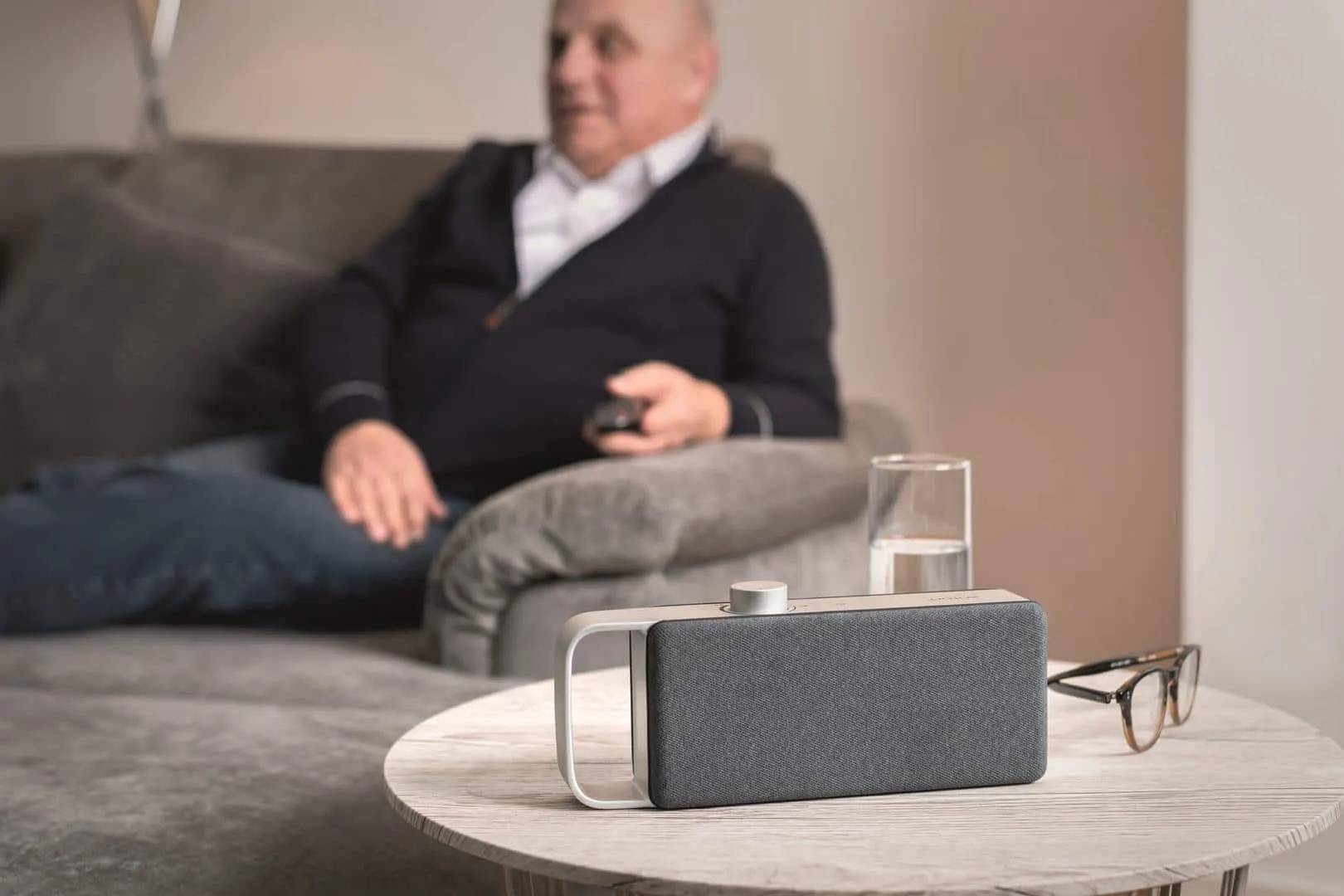
A TV speaker for seniors brings the television sound to where it is needed. It highlights speech from the soundscape of music and effects. With increasing age, hearing changes naturally. At the same time, film productions increasingly rely on complex soundscapes. This is precisely where a TV speaker for seniors comes in, making dialogues understandable again without the volume becoming uncomfortably loud for everyone else in the room.
Why TV Sound Becomes Harder to Understand with Age
Speech intelligibility on television is not a purely subjective feeling. Several factors combine to make dialogues increasingly difficult to understand with age. The causes lie in hearing itself, in the nature of modern film production, and in the design of today’s televisions.
Age-Related Changes in Hearing
Human hearing changes naturally with increasing age. The perception of high frequencies, in particular, declines. Many consonants like S, F, T, or K fall precisely within this range. When they blur, clearly spoken language quickly sounds like indistinct mumbling, even at full volume.
Complex Sound Mixing of Modern Productions
Current films and series are mixed in multi-channel audio formats intended for systems with multiple speakers. Dialogues, music, and effects are distributed among different speakers. On a normal television, all audio tracks end up together on the built-in speakers and overlap. Speech that was clear in the foreground in the studio thus disappears into the soundscape of music, atmosphere, and effects.
Flat Design of Televisions
Today’s flat-screen TVs are extremely slim, leaving little room for proper speakers. Often, the speakers are located on the back or bottom of the device and project sound backward or downward. What reaches listeners on the couch is often only indirect, muffled sound. Acoustically, possibilities that could be realized in a more voluminous housing are lost.
Why Turning Up the Volume Is Not a Real Solution
The obvious reaction to indistinct TV sound is simply to increase the volume. In practice, this often creates more problems than it solves and leads to household conflicts.
Burden on Others in the Household
If the TV needs to be turned up significantly louder, it affects housemates, partners, or neighbors. In multi-family homes, consideration becomes a constant issue. In one’s own living room, family members quickly retreat. A shared TV evening quickly becomes a solitary experience because others cannot tolerate the high volume.
Volume Does Not Solve the Comprehension Problem
Higher volume does not automatically mean better speech intelligibility. If the balance between speech and background noise is uneven, all components become equally louder. Voices remain overlaid by music and effects, just at a higher level. Action scenes then become painfully loud, without making quiet dialogue scenes any more understandable.
Standard Speakers Often Emphasize the Wrong Frequencies
Many additional speaker systems are primarily designed for a room-filling soundscape with powerful bass. This can be impressive for film scores or action scenes. However, it does not necessarily improve speech intelligibility, as these devices often emphasize frequency ranges that already overlap dialogues. A device that connects to the TV and is specifically tuned to optimize dialogues and speech takes a different approach to solving this problem.
How a TV Speaker for Seniors Works
TV speakers for older adults with hearing impairments function differently from classic home theater solutions. They have two central tasks: first, to bring the sound closer and clearer to the listener, and second, to highlight speech more distinctly.
Structure Consisting of a Base Station and Mobile Speaker
Typical systems consist of two components. A small base station is connected once to the TV and taps into its audio output. The actual speaker is portable and powered wirelessly, just like the OSKAR TV speaker. It is placed where the sound is to be heard, for example, on a side table, coffee table, or directly next to an armchair. The distance to the TV then no longer matters for intelligibility.
Wireless Transmission to the Listening Position
The connection between the base station and the speaker is wireless. Typically, it is fast enough to keep picture and sound synchronized. This eliminates cables running across the living room. Sound no longer has to travel across the entire room but reaches the ear directly from a short distance. Room reverberation, carpets, and furniture no longer absorb sound. Background noises from the kitchen or street also become less significant.
Real-Time Speech Optimization
The actual core of such systems is sound processing. Algorithms continuously analyze the audio signal and boost the frequency ranges of human speech. Music and effects are reduced. Unlike a mere volume increase, this changes the mix between voice and background. Speech moves to the foreground, and the soundscape recedes. For the OSKAR TV speaker, this technology was developed over two years in collaboration with research institutions, hearing acousticians, and sound reproduction specialists.
Constant Volume Without Sudden Jumps
A typical characteristic of television is sudden volume jumps. A quiet dialogue scene is immediately followed by a loud scene, a trailer, or a commercial block with an extreme volume increase. The result is a constant hand on the remote control, turning the volume down, then up. Automatic level adjustment in TV speakers for seniors limits these peaks and, conversely, gently boosts very quiet passages. The perceived volume thus remains consistent throughout the evening, eliminating the need for constant readjustment. It is important that good level adjustment does not flatten everything. Dramatically intended tension arcs are preserved, such as a scene that slowly increases in intensity. Only the unpleasant jumps between different programs, content, or commercial breaks are smoothed out.
What to Consider When Choosing
Not every device on the market is actually suitable for seniors. An honest assessment of the functions that truly matter in everyday life is important. Four aspects stand out particularly.
Effective Speech Enhancement
A mere volume increase is not enough. The device should demonstrably be able to boost speech frequencies and dampen background noise. Different sound profiles, for example, for movies, news, or sports broadcasts, are helpful. It is crucial that speech intelligibility actually improves, and not just the overall volume increases.
Simple Operation Without a Learning Curve
A TV speaker for seniors must function intuitively. A few large buttons, an easy-to-grip control dial, and clearly legible labels are more important than hidden menus or smartphone apps. Those who already find a remote control exhausting do not want to learn a second complicated control system. With the OSKAR TV speaker, a single control dial handles the volume and turns the device on or off by clicking into place. Next to it, there is only one other button to adjust the dialogue optimization. No further controls are necessary.
Mobility and Battery Life
A portable device with its own battery can be moved to the kitchen, bedroom, or patio. Prerequisites are sufficient battery life and a comfortable carrying handle. The OSKAR TV speaker offers up to 20 hours of battery life per charge. If the base station also serves as a charging cradle, recharging becomes as simple as setting down a cup. No fumbling with cables, no searching for an outlet.
Connections and Compatibility
For the speaker to work with the existing TV, the connections must match. Common options are an optical digital output (Toslink) and an analog 3.5 mm jack output. The OSKAR TV speaker uses these two connections and additionally HDMI ARC. This means it works with all common TVs, including Smart TVs with analog or digital audio outputs. Before purchasing, it is worth checking the back of your TV or its user manual.
What Can Be Combined Well with a TV Speaker
Even if a TV speaker for seniors noticeably improves the listening experience, some TV settings can be practically utilized.
Check TV Audio Settings
Many televisions offer a speech enhancement mode in their settings, often under names like Clear Voice, Dialogue Mode, or Speech Filter. The ARD standard “Klare Sprache” (Clear Speech), for example, is broadcast as a second audio track and can be selected via the TV’s audio menu. A simple adjustment to the equalizer can also help. A slight boost of the upper mids often improves speech intelligibility.
Subtitles as Visual Aid
Subtitles are a free and very effective addition. On public broadcasters and most streaming providers, they can be displayed at the touch of a button. What the ear does not clearly grasp, the eye compensates for. This often provides supportive relief in everyday life.
OSKAR as a TV Speaker for Older Adults
OSKAR by Faller Audio is a TV speaker with an integrated speech amplifier function, specifically developed for the requirements described. The device combines the function of a portable TV speaker with targeted speech optimization. Its operation is understandable without explanation.
Speech-Optimized Sound Directly at the Listening Position
OSKAR consists of a small base station and a portable speaker. The base station is connected to the TV, and the speaker is placed where the sound is to be heard, such as on a side table, coffee table, or next to a reading chair. The base station transmits the sound wirelessly and optimizes speech in the process. Dialogues are clearer in the foreground, while music and effects are reduced.
Operating Concept for All Ages
The operating concept follows a simple principle: one rotary knob and one button. There is no app, no nested menus, and no hidden settings. The rotary knob controls the volume and turns the device on or off by clicking it. The second button adjusts dialogue optimization. This clarity is not a renunciation of technology, but a conscious decision for a target group that wants to use technology but not study it.
Undisturbed TV Viewing for the Whole Family
Because OSKAR brings the sound directly to the listening position, the TV can remain at normal room volume or even run quieter. Others in the room still hear the sound from the TV and do not have to expose themselves to the loud levels that would otherwise be necessary. This allows for shared TV viewing, even if hearing abilities differ. OSKAR works with all common TVs that have an analog or digital audio output.
Frequently Asked Questions
A TV speaker for seniors is usually a portable device that wirelessly receives TV sound from the television and reproduces it directly at the listening position. Unlike normal speakers, it specifically highlights speech, so that dialogues remain understandable even with declining hearing. The TV can continue to run at normal room volume.
In most cases, yes. The base station connects to the TV via an analog jack output or an optical digital output (Toslink). Practically all current televisions offer at least one of these two connections. Before purchasing, it is worth taking a quick look at the back of your TV.
No, a TV speaker is not a medical device and does not replace a fitted hearing aid. It is a supplement specifically for watching television. If you feel your hearing has deteriorated, you should also have a hearing test performed by a hearing acoustician or ENT doctor.
A soundbar is designed for room-filling sound with powerful bass and fills the entire room with sound. A TV speaker for seniors, on the other hand, brings the sound directly to the listening position. Instead of amplifying speech within the soundscape, it highlights it. Furthermore, it is usually much easier to operate than a soundbar with app control.
The base station is connected to the TV’s audio output with a supplied cable, either via jack or optical cable, depending on the model. The mobile speaker then automatically finds the base station and is immediately ready for use. Separate configuration is generally not necessary.