
What is a TV Speech Amplifier?
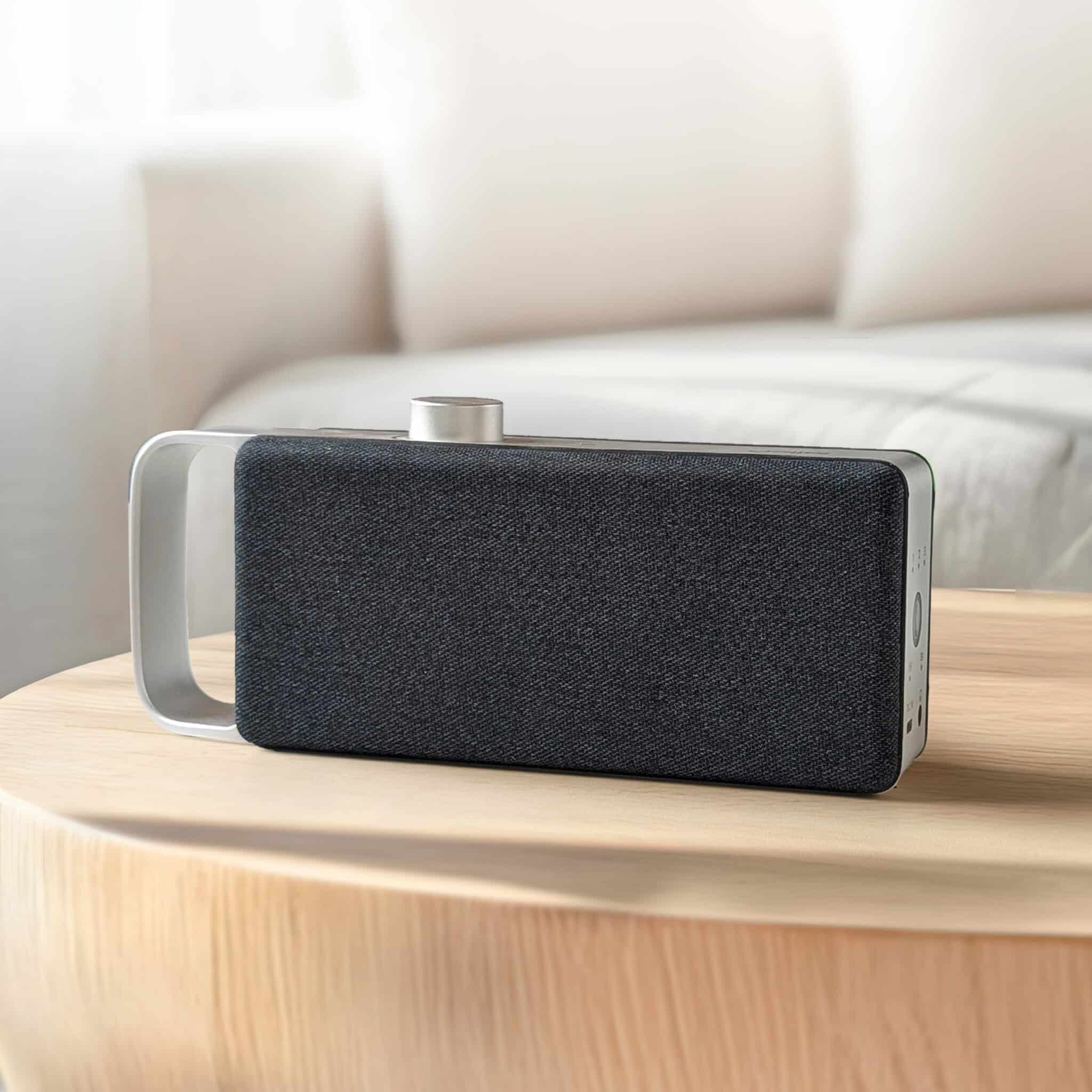
A TV speech amplifier is a device that processes television sound so that speech and dialogue stand out more clearly. Many people struggle to understand individual words while watching TV, even when the volume is set appropriately. The cause is often not just individual hearing ability, but also the sound mixing of modern programs, background noise, and the acoustics of the room.
A TV speech amplifier is designed to make voices more intelligible without simply increasing the overall volume. The best devices also bring the sound closer to the listener. This allows speech to remain clear without the television having to be uncomfortably loud for everyone else in the room.
What is a TV Speech Amplifier?
A TV speech amplifier is a mostly wireless, portable speaker system that processes television sound with the goal of better speech intelligibility. A small transmitter station is connected to the TV and transmits the audio signal to a speaker located directly at the seating area. There, voices stand out more clearly, while music and effects recede into the background.
In this context, people often refer to a hearing amplifier for the television. However, this is only partially correct. Strictly speaking, a TV speech amplifier is more specialized because it does not amplify arbitrary ambient noise, but rather focuses the TV sound on speech and dialogue. This also distinguishes a TV speech amplifier significantly from simply increasing the TV volume, where speech and background noise increase to the same extent.
What Problem Does a TV Speech Amplifier Solve?
The core problem is usually not a volume that is too low, but rather an unfavorable ratio of speech to background. In modern film and series productions, dialogue, music, and sound effects are mixed across many channels. On the stereo speakers of a flat-screen TV, everything ends up together, and voices easily disappear among the other sound components.
Anyone who turns up the volume in this situation amplifies speech and background noise equally. This does not make the dialogue clearer; on the contrary – everything just gets louder.
A TV speech amplifier solves exactly this problem. Instead of raising the overall level, the device improves the ratio of speech to everything else. Other external solutions that simply amplify the entire audio signal also raise background noise to the same extent and do not change this ratio.
How Does a TV Speech Amplifier Work?
Technically, a TV speech amplifier works in two interlocking sequences. First, the components of the audio signal important for speech are identified and boosted, and then distracting sound components are reduced. Processing occurs with the lowest possible delay to ensure that picture and sound remain synchronized.
Emphasizing Speech and Dialogue
Depending on the model, an algorithm and a dynamic equalizer continuously analyze the TV sound and emphasize the parts where speech occurs. This is intended to make speech more clearly perceptible without “just” making the entire TV sound louder. The higher frequency ranges in particular contribute a lot to intelligibility because that is where the consonants lie that make words distinguishable. If the speech-relevant parts are specifically emphasized, individual words can be separated from one another more easily again.
Reducing Distracting Background Noise
Parallel to this, many devices reduce sound components that do not belong to speech, such as background music, atmosphere, and effect noises. Many models offer several levels or speech filters for this purpose, so that the intensity of the processing can be adapted to the respective program and one’s own hearing needs. A quiet documentary logically requires less intervention than an action film with a loud soundscape.
Why Proximity to the Sound Helps When Watching TV
In addition to sound processing, the position of the speaker plays a major role. In a flat-screen TV, speakers are usually located at the bottom or back of the television. As a result, the sound primarily radiates backwards or downwards. A portable TV speech amplifier, on the other hand, can be placed directly next to the seating area so that the optimized sound arrives from a short distance.
This proximity has a double effect. Firstly, a high proportion of speech reaches the ear without having traveled through the room first and losing clarity. Secondly, the TV speech amplifier often works independently of the TV volume. Depending on the TV settings, the television can run at a lower volume while the person listening sets their own, clearly audible level on the speech amplifier.
Clear sound from close range also reduces the effort required for listening. Research on so-called listening effort describes that signals that are difficult to understand or overlaid by background noise tie up additional mental resources. If speech arrives at the ear already clear and well-separated, this effort decreases, and even long movie nights are less fatiguing.
Who Can Benefit from a TV Speech Amplifier?
A TV speech amplifier can basically be used by everyone with added value. People who find dialogue while watching TV to be strenuous or unclear benefit the most. This often affects individuals whose hearing declines with age, but also people who have difficulty with dialogue especially during music, effects, or at a greater sitting distance. A significant benefit arises in households with different hearing needs, because one person receives the amplified sound at their own seat while the television remains at normal room volume for everyone else.
Typical signs that a TV speech amplifier might be a good fit include:
- Dialogue sounds unclear even though the TV is set to a high volume.
- There are regular discussions in the household about the volume being too loud or too quiet.
- Background music and effects often drown out the voices.
- Longer films or series noticeably strain the listening effort.
- Subtitles are increasingly needed as an aid.
Because many devices are portable, the possibilities for use are not limited to the television. A speech amplifier can often also be connected to radios, music systems, or computers and used for news, audiobooks, or podcasts in other rooms.
Which Features are Important?
When choosing a TV speech amplifier, it makes sense to focus less on having as many extras as possible and more on the points that really count for clear speech and easy use. The following properties are particularly relevant:
- Multiple levels of voice optimization or speech filters to adapt the processing to the program and hearing needs.
- Clear speech reproduction through suitable speaker technology.
- Simple operation, often via a single button or a rotary dial, without unnecessary menus.
- Suitable connections for older and modern televisions, i.e., an optical audio output and an analog jack connection.
- Sufficient wireless range and a battery life that lasts through an entire evening of television.
- A carrying handle for transport to other rooms as well as a headphone jack for undisturbed listening.
Latency, i.e., the delay between picture and sound, should be low enough that lip movements remain synchronized.
What are the Limitations of a TV Speech Amplifier?
A TV speech amplifier is an audio device. It is not a substitute for a hearing aid or professional hearing advice and cannot compensate for profound hearing loss. In the case of significant hearing problems, a consultation with a specialist is advisable, regardless of whether a speech amplifier is used as a supplement.
There are also technical limits. If the broadcast sound mix is already very unclearly mixed, not every word can be recovered at will. A speech amplifier improves the ratio of speech to background, but it does not create information that is missing in the original signal. Factors such as highly reverberant room acoustics can further influence intelligibility and are only partially mitigated by the device.
OSKAR as a TV Speech Amplifier
OSKAR by faller audio is a TV speech amplifier that combines the described principles in a compact, portable device. It analyzes the TV sound, optimizes it for better-understood dialogue, and brings it wirelessly closer to the listening area.
How OSKAR Makes Speech More Intelligible
At its core is a voice optimization technology that emphasizes frequency bands important for speech and minimizes distracting background noise. Three levels of voice optimization are available for this purpose, so that the processing can be adapted to the respective program. Sound is provided by two full-range speakers and a passive driver, which enable clear speech reproduction. Because OSKAR reproduces the optimized sound directly at the seating area, the television often does not need to be set as loud for speech to remain intelligible.
Connection and Operation in Everyday Life
OSKAR consists of a base station, which serves as both a transmitter and charging station, and the portable speaker. The base station is connected to the television via an optical or an analog jack cable and works with common devices including Smart TVs. The audio signal is transmitted wirelessly over a range of up to approximately 30 meters, so the speaker can also be taken into other rooms thanks to the carrying handle. The integrated lithium-ion battery provides energy for about 16 hours of operation; a full charging process takes about four hours. The speech-optimized sound can also be heard undisturbed via the headphone jack.
Frequently Asked Questions
A TV speech amplifier is a mostly portable speaker system that specifically processes television sound for better speech intelligibility. A transmitter station on the TV transmits the sound wirelessly to a speaker at the seating area. There, voices are emphasized and distracting background noises are reduced. Unlike simply turning up the volume, a TV speech amplifier does not just change the volume, but the balance between speech and background.
A TV speech amplifier is primarily suitable for people who have difficulty understanding dialogue while watching TV, even though the television is set loud enough. It is also helpful in households with different hearing abilities, because one person hears the optimized sound at their own seat while the television remains at a normal volume for others. People whose hearing declines with age often benefit. A TV speech amplifier is an audio device and does not replace professional hearing advice.
When turning up the volume, speech and background noise increase equally, so dialogue hardly becomes clearer in relation to music and effects. Additionally, high volume can lead to conflicts with housemates or neighbors. A TV speech amplifier takes a different approach and improves the ratio of speech to background instead of just raising the overall level. This allows the volume to remain more pleasant while speech intelligibility is improved.
The base station of a TV speech amplifier is connected via the audio output of the television, usually by an optical digital cable (TOSLINK) or an analog jack connection. From there, the audio signal travels wirelessly to the portable speaker. Many devices work with common televisions including Smart TVs, provided a suitable audio output is available. Where available, the optical connection is generally the better choice for sound quality.
Many TV speech amplifiers have a headphone jack through which the speech-optimized sound is output directly. This is practical if you do not want to disturb those around you at all, for example late at night. The voice optimization also works through headphones. Whether this function is available depends on the respective model.