
Toslink – The optical audio output on the TV
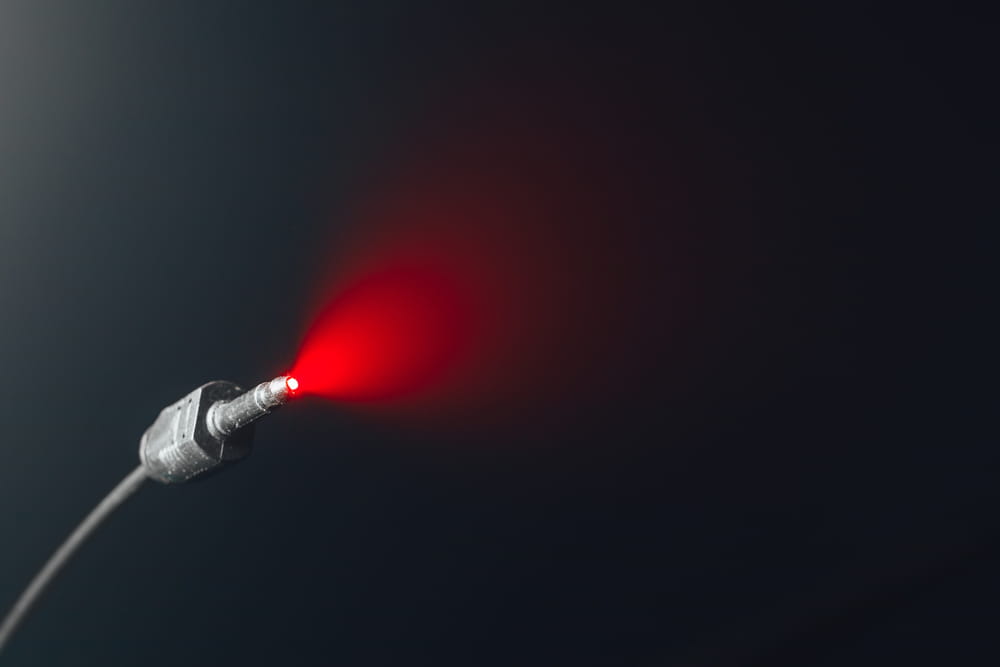
Toslink is the common optical interface used by many televisions to output digital audio. The sound does not leave the device as electricity, but as light. A thin fiber optic cable carries it to the soundbar, amplifier, or the base station of a wireless speaker.
Depending on the TV settings, Toslink transmits either stereo or compressed multi-channel sound. It is also important not to bend the optical cable too sharply and to keep the connectors clean to ensure the signal is transmitted reliably.
What is Toslink?
Toslink is the optical connection through which digital audio data travels as light pulses from one device to the next. This refers to the socket, connector, and fiber optic cable. What is actually transmitted is a different matter: that is the responsibility of the digital audio format. In everyday use, however, both terms are often lumped together.
Terminology and Standardization
Toslink is a trade name that has become established for the optical audio interface in the consumer sector. However, behind it lies a standardized connection. In standardization, the square connector is known as Type F-05, a rectangular connector with a sliding lock specifically intended for digital audio and video devices. The same standard covers both glass and plastic fibers equally.
In retail, this design therefore appears under several names. Optical digital cable, fiber optic cable, and audio light guide usually refer to the same product. When looking for a suitable cable, you should pay less attention to the name and more to the shape of the connector. If the square connector fits into the socket, then the cable fits.
Relationship to S/PDIF
Toslink describes the optical connection and thus the path the signal takes. The digital audio signal transported on it follows the IEC 60958 interface for typical living room devices, which is often referred to as S/PDIF. The third part of this series of standards is important for household use, as it explicitly describes consumer applications.
The same digital audio interface can also be transmitted electrically, in which case a coaxial cable with an RCA connector is used. Because both paths are based on the same interface, they can be converted into one another using small converters. In the device menu, you will find terms such as Digital Out, Optical Out, or simply Digital Audio Output. The term Toslink itself appears there rather rarely or not at all.
The path of sound through the fiber optic cable
No electricity flows between the television and external TV speakers with this connection. Instead, light travels through a thin fiber made of plastic or glass. This design brings a decisive, audible advantage, which also explains why a poor connection manifests itself differently here than with a copper cable.
From electricity to light and back
Inside the television’s output is an optical transmitter that converts the electrical digital signal into light pulses. These pulses follow the encoded data stream of the digital audio interface. At the other end is an optical receiver. It converts the pulses back into an electrical signal. If you pull out the plug and look into the open socket, you will therefore see a faint red light there.
Inside the fiber, the light is repeatedly reflected at the interface between the core and the cladding, thus remaining within the line. Unlike an analog connection, a deteriorating transmission does not usually manifest as increasing noise or a gradual decline in sound quality. If the optical signal is attenuated too much, dropouts are more likely to occur, or the connection may break off entirely.
Separation without ground connection
There is no electrically conductive connection between the two devices via this path. This means that no electrical circuit can be completed through the housings and the signal cable. It is precisely such circuits that can produce an audible hum in copper connections between devices plugged into different power outlets.
There is another point to consider. Light in a fiber is not affected by electromagnetic fields in the environment. A power supply, a dimmer, or a radio transmitter next to the cable therefore plays no role in the transmission. Anyone struggling with interference noise in an analog connection can often find a solution via the optical path.
Audio formats via the optical output
The optical output does not simply output sound, but a data stream in a specific format. If this format does not match the connected device, it remains silent or produces noise. This is managed in the television’s audio menu. An incorrect setting is the most common reason why a newly established connection does not work initially.
PCM and Bitstream in the audio menu
Under the audio output settings, there is also an option for the digital output format. The choices typically available are PCM and Bitstream, sometimes supplemented by an automatic setting. With PCM, the television usually outputs uncompressed stereo sound via the optical output. If a multi-channel source needs to be reduced to stereo for this purpose, the television handles the corresponding processing. This is exactly what such an interface is designed for; specifically for mono and stereophonic programs with linear PCM up to 24 bits per sample and sampling rates from 32 kHz.
With Bitstream, on the other hand, the television outputs an encoded audio stream that the connected device must decode itself. Depending on the television and the source, compressed multi-channel formats can be transmitted this way. A separate standard describes this exact case, namely the embedding of non-linearly encoded bitstreams into the same interface. If the receiving device cannot process the format, no sound will be produced. Switching to PCM then helps in most cases.
The capacity of the optical output is not sufficient for high-bitrate or uncompressed multi-channel formats. In these cases, the path is via HDMI with eARC, i.e., via the Enhanced Audio Return Channel.
| Feature | Strength | Limit |
|---|---|---|
| Interference | no conductive connection, insensitive to electromagnetic fields | contamination and attenuation in the light path have an effect instead |
| Availability | available on many televisions, including older devices | not built into every device; a look at the back is worthwhile |
| Audio formats | stereo and compressed multi-channel sound | no room for uncompressed multi-channel formats |
| Device control | remains free when all HDMI ports are occupied | no control commands; HDMI is responsible for that |
| Cable distance | independent of cable quality within range | limited length and sensitive to sharp bends |
| Volume | adjustable on the receiving device separately from the TV | TV remote often has no effect |
The optical output has clear strengths in terms of interference immunity and availability. The limitations lie in the audio formats, device control, and cable distance.
Conversion to an analog signal
A data stream, not audible sound, comes out of the optical socket. Headphones or active speakers cannot work with this. A device is required to translate the data back into voltage, namely a digital-to-analog converter.
Such converters are available as small boxes with an optical input and RCA or jack output. These solutions usually require their own power supply via USB or a power adapter. Wireless headphones, neck speakers, and portable TV speakers also work this way, as their base station handles the conversion at the same time. It is important that the television outputs a format that the converter can handle.
Connectors, cables, and installation
Optical cables look inconspicuous and are therefore often treated like power cables. However, this is not the case, as there is a fiber inside with clear mechanical limits. Different rules also apply to length than with copper. A few aspects make the small but subtle difference between a stable connection and recurring dropouts.
Standard connectors and Mini-Toslink
The common design is the square connector with a beveled corner. The socket often has a small flap that you push inward when plugging it in. It keeps dust away from the optics. In addition, there is a smaller variant that looks like a 3.5 mm jack plug and is called Mini-Toslink. It is mainly found on laptops and on combo jacks that work either analog or optically depending on the plug.
Adapters or cables that are square on one side and round on the other facilitate connection between the two designs. On a television, the square shape is the standard. The socket there is normally labeled Optical or Digital Audio Out.
Plastic fiber and glass fiber
Two materials are possible for the internal light guide. Simple cables use a plastic fiber. This is sufficient for short distances in the living room. Cables with a glass fiber core attenuate the light less and are therefore suitable for longer distances.
Which length works best, however, does not depend on the cable alone. Transmitter, receiver, and fiber type all come together here, which is why component manufacturers specify their own ranges for their modules. There is therefore no universally applicable maximum length for Toslink. For longer distances, you should therefore opt for higher-quality cables if in doubt.
Within the appropriate range, however, an expensive cable does not sound better than a cheap one. What a higher-quality cable really offers as added value is a reserve for long distances and a more robust casing.
Bending radius and installation
If the fiber is bent sharply, the light hits the interface at an unfavorable angle and leaves the conductor. This makes the signal weaker, which manifests as dropouts or missing sound. With a real glass fiber, the core inside can even break without it being visible from the outside.
For this reason, the cable should be routed around corners in a wide arc and not over a sharp edge. Behind the television, it should not be pressed against the wall. It also has no place under a furniture leg or under the edge of a carpet. A little slack at the connector also does no harm, so that there is no tension on the socket.
Protective caps and clean end faces
New cables have small plastic protective caps on both ends. They are easy to overlook and are occasionally mistaken for part of the connector. They are often left on, which results in a connection simply not being established.
If the cable is unplugged and left lying around, the cap must be put back on the connector. The reason for this is the end face of the light guide. Dust and fingerprints attenuate the light there and reduce the range. If the surface is dirty, clean it carefully with a clean, lint-free cloth. You should strictly avoid touching the end face with your fingers.
Troubleshooting the optical output
If no sound is produced after plugging it in, it is often not the cable itself. Usually, the TV settings do not match, or the television is still outputting the sound through its own speakers. Another common case concerns the volume control, which suddenly can no longer be changed with the usual remote control. Both have to do with the way this connection works.
No sound despite connection
The following check sequence is recommended:
- In the audio menu, switch the output from the TV speakers to the optical output. Many televisions do not recognize the connected device here automatically.
- Set the digital output format to PCM, as almost every receiving device can handle this.
- Pull out both connectors and check whether red light is shimmering in the sockets and whether the end faces are clean.
- Feel the cable along its entire length and look for kinks, especially directly behind the connectors.
- To rule out other issues, connect a second cable or a second source and turn the television off and on again.
If none of this helps, the socket itself may be mechanically damaged. The small flap occasionally jams and then no longer holds the connector at the correct depth. This is hardly visible from the outside.
Volume and time offset
The optical output carries only audio data. Control commands between devices, such as those exchanged by HDMI CEC, are not included. Many televisions therefore apply a fixed level to the optical output. The volume is then adjusted on the connected audio device and not via the normal TV volume. However, some televisions offer a setting in the audio menu to change the optical output from a fixed to a variable level.
In addition, the timing aspect can play a role. Every conversion and every processing step in the receiving device takes a few milliseconds, which can cause the sound to lag behind the picture. Many televisions have an audio delay setting for this, which can be adjusted in small steps. It is usually located right next to the output format selection.
Frequently Asked Questions
Toslink is the common optical connection for digital audio in consumer electronics. Through this connection, the TV sound reaches a soundbar, an amplifier, or the base station of a wireless speaker. Picture and control commands are not transmitted through it; HDMI is responsible for that.
The socket is square with a beveled corner and is thus shaped significantly differently than HDMI or USB. It is often closed by a small flap, behind which a faint red light can be seen as soon as the television is running. Labels such as Digital Audio Out, Optical, or an abbreviation for the optical output can be found. On very slim devices, the connection is occasionally located on a separate connection box instead of directly on the housing.
With a stable digital connection, a more expensive cable does not automatically improve the sound. However, differences in material and workmanship can influence how reliably the signal arrives over longer distances or with tight installation. If the attenuation becomes too great, dropouts are more likely to occur than a gradual deterioration in sound. For the usual two to three meters in the living room, a simple cable is therefore sufficient.
Couplers for two optical cables exist, but they are not a good idea. Light is lost at every junction, and the range decreases further, even though it is already limited. It is more sensible to use a single cable in the appropriate length, with a glass fiber core if in doubt. For really long distances across the room, active solutions with their own power supply are better suited.
Toslink transmits digital audio optically and does not carry device control. HDMI ARC sends the sound back to the audio device via an HDMI cable and, together with HDMI CEC, can also handle control functions such as volume adjustment. For high-bitrate multi-channel formats, HDMI eARC also offers significantly more bandwidth than the optical path. On the other hand, the optical output often remains usable when all HDMI ports are occupied.